Amelia Freeman-Lynde: Maker, Owner of Freeman's Creative
Creatives in Conversation: I believe that we can learn so much from each other and I am fascinated by the ways in which artists of all mediums move through the creative process. Each interview features a different local artist as we discuss the challenges and joys that come from accessing and living with their creativity.
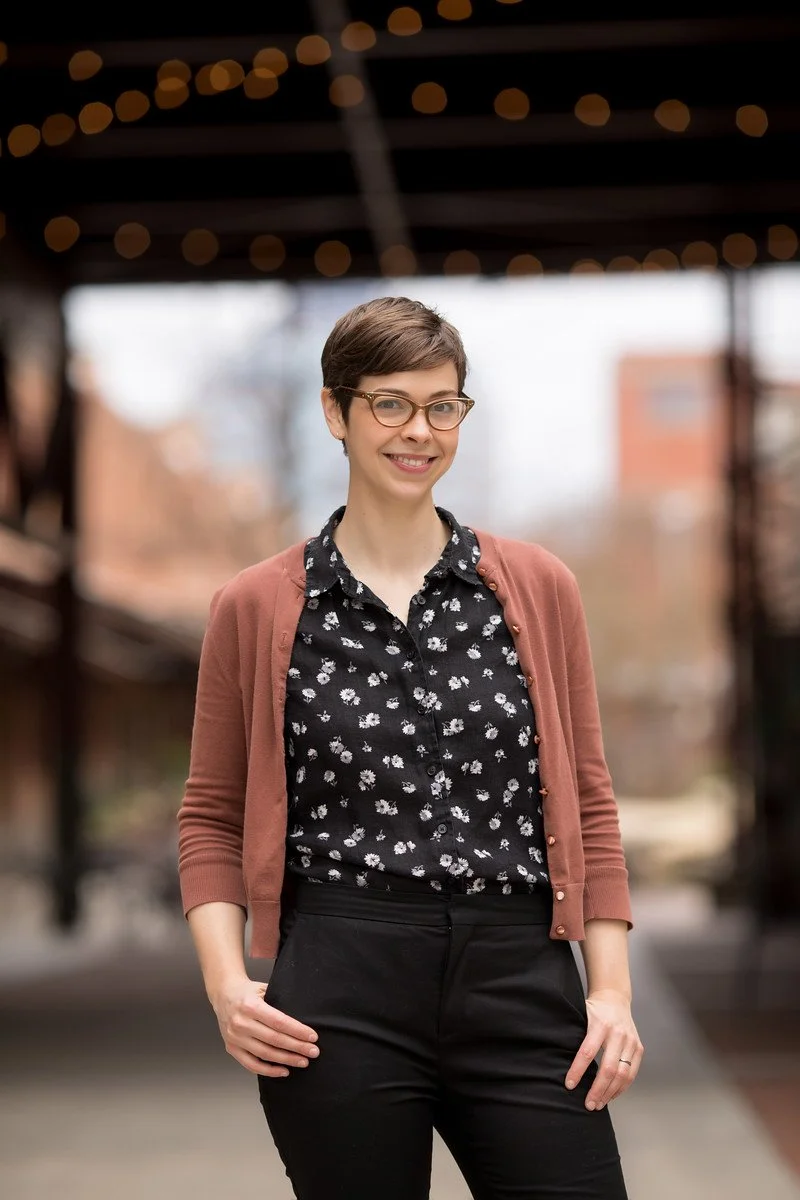
Amelia Freeman-Lynde (Photo: Morgan Henderson Photography)
Amelia Freeman-Lynde is the owner of Freeman's Creative, a handcraft supply store in Durham, NC. Amelia has worked as a theatrical propmaker, restaurant manager, and handcraft instructor. She has been knitting, sewing, and making things since her childhood in Athens, GA. Sharing her love of handcraft with Durham's creative community is a dream come true!
How did you get into crafting?
I've always been crafty and that is probably from being from a generally crafty family. I learned to knit from my grandmother when I was about eight years old and I've done a lot of sewing projects with my mom. The things I got in trouble for as a kid were, like, cutting a piece out of my bedspread to make a doll outfit or unsupervised, unauthorized crafting. My background is in theater. In third grade I was in my first play, and I did theater pretty much from that point on through college and into my first round of professional life, where I was a theatrical prop maker.
What drew you to that very specific niche within theater?
“I identify more as a maker than an artist. Most of the time I’m not trying to communicate anything with my making. I enjoy the practical side of it. I think art is a communication tool in a way that making doesn’t have to be.”
In high school our drama teacher required everybody to take part in every process. So if you wanted to be in shows you needed to come to set call and build sets and costumes. And then when I went to college, I had a work-study job. I thought I wanted to do costumes. I applied to be a work-study student in the costume shop. And another student was there at the same time and she did better on her sewing test. So she got hired. And so they sent me down to the scene shop and we were building sets and making props for all the shows at my college.
My thesis was in acting and directing but I did a big show my senior year where I was the props coordinator. And once I graduated, I was kind of like, okay, I could audition and get a job at a coffee shop and try and make that work. And my parents [said they’d buy me headshots for graduation], which are super expensive. And I was like, you know what? I think I am not going to try to be an actor. I had some props experience and the person who ran the scene shop at my college was like, oh, somebody I know is looking for a props run crew position. That was backstage, making sure all the props are in the right place at the right time. So I got a job there and from there did a lot of stage hand work on the props end of things, which usually is more on the repair and coordination end. And I started to do a little bit more of the prop mastering where you're responsible for sourcing and creating all of the props. Any world that's created on stage has to have the stuff of that world, which can be a straightforward process or can be a little bit more involved.
Did it make you think differently about theater or about objects that are on stage?
Sure – if you watch a movie or a TV show with me, sometimes I'm like I wonder how they got that thing to work like it did, or somebody had to source that or somebody had to make sure that thing worked. Definitely when I see a show, I'm just like, do you know how many people are involved beyond the three people that are on stage?
I think people have an idea about arts careers, that they're cushy or not real work. My experience as a professional in the theater was that people work extraordinarily hard and are very talented and also the skills are super transferable.
How do you think that your life in crafts and prop building and prop mastering prepared you for opening up a handcraft supply store?
I think theater is a really practical major because you do build really useful skill sets. It's a lot of communication skills. It's a lot of time management, working with a team and setting goals. And aside from the practical hands-on craft skills, a lot of it is just [making a] budget and making sure that everybody's on the same page. So that part is very transferable.
Small business life is kind of the ultimate in creativity because you do not know what challenges are going to come your way. And certainly two years ago I did not know that we would be making it through a pandemic. So that has required all of our creative resources just to keep going. I've described the past two years as small business challenges on steroids. You are always going to be dealing with challenges and delays and setbacks and problems, but usually they may be a little bit more spread out and not quite as ultra-concentrated.
Our mission [at Freeman’s Creative] is that creativity is a life skill. And I do think practicing on handcraft projects and things that are enjoyable and a little bit lower stakes is really good practice to say, Okay, we can problem solve. We can think of a way through this. We can encounter a setback and rethink. And I think it's really helpful for people to realize that they are capable and that setbacks aren't the end of the road. I do think that [message] can be missing in the education system.
What does living a creative life mean to you?
I often say that I think of myself as a maker rather than an artist, which kind of goes along with creativity and living a creative life. So I do think there's a lot of preconceived notions about what it means to be creative and especially around being an artist, which I think can be very high stakes and give people a sense that they aren't cut out to be creative or aren't cut out to be an artist.
I hope that people can realize that the root of creativity is the word create. So if you make things, if you make bread, if you make miniatures, if you make clothes, you make a garden ... we're creative people, regardless of whether we're artists or can paint or come up with an idea. You're still creative, even if you follow a pattern or copied something, because you're creating something that didn't exist before. So for me a creative life is just being aware of my own ability to create things. And that can be ideas as well.
I like how you were saying you identify more as a maker than an artist. I have never thought of it that way before. What does it mean to you to be a maker?
I like to make stuff. I find it enjoyable, and I also have that knowledge that even if I encounter a challenge that I haven't encountered before, my creativity is what is going to allow me to adapt and meet that challenge. And so for me a maker is someone who enjoys hands-on creativity and likes the physical manifestations of creativity. I like to do stuff with my hands. I really like to see the process. I haven't ever had a job where you don't get to see the tangible reward of your work.
What has been your biggest creative challenge and how did you move past it? Or are you still working on that?
To certain degree, the business is my greatest creative challenge which I hope that I'll be working through for many, many years. Life is the biggest creative challenge. (laughs) The words I keep coming back to are creativity, making, problem solving. And when I'm hiring people and training people here, I do tell them our focus needs to be on problem solving rather than selling stuff. And I just feel like you naturally are able to sell people things and make money as a business if you're able to solve problems for people. Problem solving is a big part of running a small business and it's certainly drawn on all of my creative resources.
“Our mission [at Freeman’s Creative] is that creativity is a life skill. I think practicing on handcraft projects that are enjoyable and lower stakes is really good practice to say, Okay, we can problem solve. We can think of a way through this. We can encounter a setback and rethink. It’s really helpful for people to realize that they are capable and that setbacks aren’t the end of the road. I do think that [message] can be missing in the education system.”
Who or what are some creative influences of yours?
Family members. A lot of my basic skillset I learned from my mother and my grandmother and other members of my family. Most of my early woodworking experience was with my grandfather. My grandparents were real serious gardeners. My dad is a retired geology professor and a memorable creative experience with him was he taught a dinosaur class. And so, he saved our Thanksgiving turkey carcass one year and dissected out all the bones to show how birds are really dinosaurs. And then our dog ate the whole thing. (laughs) Certainly any of the art teachers that I had in school and my high school theater teacher was a big influence. I don't tend to have particular icons.
These last couple years of living during a global pandemic have been difficult. Would you say it's made you think differently about your own maker practice?
Sure. There definitely were some perks to being an online only business. We just ended up having limited hours for pickup and filling online orders is just a lot more straightforward. So, I actually had a lot more time to work on [my own] projects. Now that we're reopened, I do find that most of my time and energy goes towards that aspect of the retail business, which I enjoy. It was important to reopen and it has brought a lot of the life and energy back to what this was supposed to be. I didn't set out to start an online business. I really did want to have a community space where people could see things and feel things in person. I think [the pandemic] made me think a lot about how the business is structured and what I want my life to look like, which is definitely a challenge.
As I said, I identify more as a maker than an artist. Most of the time I’m not trying to communicate anything with my making. I enjoy the practical side of it. I think art is a communication tool in a way that making doesn’t have to be. I've certainly had a lot of thoughts and feelings about the past two years, but I didn't necessarily feel any pressure to change my making practice based on that because I wasn't really trying to create a record of the time or convey any sort of emotions or feelings. I was more like I'd really like a pair of green pants, so I'm going to make green pants, which is something that I like about falling into a making practice rather than an artistic practice. I just don't feel like it has to be "the best green pants" or "pants that let people know that I align with a certain philosophy." There's been a lot of pressure to make meaning out of [the pandemic].
A bunch of people picked up crafts during the pandemic and certainly a lot of new people found us during the pandemic. But a lot of our regulars [customers] said I just didn't feel like sewing for a while. Or I didn't feel like knitting for a while. I just didn't feel like myself and I didn't feel like my regular practice, or I had kids at home or I was so drained of energy that I just didn't feel like doing the things that had brought me joy before.
I benefitted from having to work really hard. There were some people in 2020 who were like, I’m so bored. Not me. I generally prefer to be busy and was still coming into work and surrounded by materials and supplies that inspire me, so I didn’t have any sort of lapse.
This interview has been edited and condensed.